
As the U.S. home improvement and construction sectors move through another year of macroeconomic and policy uncertainty, new research from the Home Improvement Research Institute (HIRI) reveals a sharp divergence in how contractors are navigating change. In particular, contractors with $1M+ in annual sales and those with Democratic political leanings are far more likely to anticipate disruption from tariffs, immigration policy changes, and regulatory shifts in 2025. Meanwhile, optimism about business prospects is strongest among larger firms and Republicans; setting the stage for a competitive landscape where agility and adaptation will determine winners and losers.
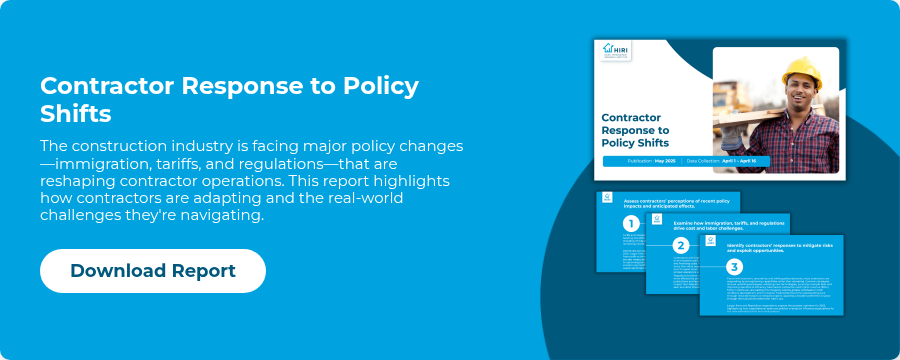
These findings are coming from HIRI’s study on Contractor Response to Policy Shifts, which HIRI members can access in full.
Tariffs Take Center Stage, But Impact Is Far from Uniform
Among all the policy factors considered (tariffs, interest rates, immigration, sustainability mandates to name a few), tariffs are perceived as the most disruptive external risk for contractors in 2025. Over a third (36%) of contractors expect significant impact from tariffs, surpassing concerns around interest rates (33%) and immigration (29%).
Bear in mind that this topline finding masks wide variation beneath the surface. A handful of these variations include how:
- Larger firms (with $1M+ annual sales) are nearly twice as likely as smaller firms to anticipate significant impact from tariffs (49% vs. 30%).
- Democrats are much more likely than Republicans to expect disruption from tariffs (56% vs. 28%), highlighting the political polarization around trade policy impacts.
- Mechanical contractors consistently report the highest sensitivity to tariff-driven disruptions, particularly around supply chain delays and material cost inflation.
Note also that homeowner’s behaviors greatly influence contractor sentiments, which helps put into context findings from this Contractor specific report, as well as HIRI’s June 2025 Size of Market forecast into better context.
Immigration and Labor Policy: Pressure Intensifies at the Top
The findings from HIRI’s Contractor Response to Policy Shifts study makes clear that those with the highest revenue and Democrats are also most likely to anticipate negative impacts from changes in immigration policy. Increased labor costs, driven by a shrinking pool of skilled workers and heightened wage pressure, are the most widely anticipated consequence.
42% expect increased labor costs, and 39% foresee fewer skilled workers due to immigration policy changes. Larger firms and Democrats report the greatest concern, underscoring how market leaders often feel the pinch of policy change first and most acutely.
For smaller firms, Landscapers, and rural Pros, these headwinds are less pronounced, likely due to simpler operational models or more stable local labor markets.
Financing Costs: The Key Macro Impact for Larger Firms
Beyond labor, financing costs have emerged as a defining pain point, especially for larger contractors. 39% of contractors overall cite increased financing costs as a major challenge, with larger firms disproportionately affected.
Other impacts include tighter cash flow, more frequent project delays, and even price cuts to meet homeowner affordability thresholds. These macroeconomic pressures are amplifying the impact of policy shifts, especially for companies that rely on significant capital or operate at scale. It can also be impacting the ways that contractors respond to promotions.
The Proactive Playbook: Upskilling, Innovation, and Efficiency
In response to this swirl of challenges, most contractors aren’t retreating, they’re doubling down on offense. The dominant theme is proactive adaptation, not retrenchment.
Improving employee skills (32%) and adopting new technologies (29%) top the list of strategies for seizing new opportunities. Larger firms (with $1M+ annual revenues) are standouts, with the highest rates of upskilling and innovation adoption.
Other forward-looking tactics include increasing job bids, entering new markets, and creating new construction methods. Cutting profit margins or delaying projects is a minority strategy, most Pros are pushing forward rather than scaling back.
Larger firms are leading on multiple fronts: up-skilling, process innovation, and technology adoption. For competitors, keeping pace with this “advance through uncertainty” mindset will be critical.

Navigating 2025: More Bids, Greater Efficiency, and a Bias for Action
When asked how they plan to meet 2025’s challenges, contractors overwhelmingly cited increasing project bids (39%) and improving project efficiency (36%) as core strategies. This is especially pronounced among mechanical contractors, who are the most aggressive in chasing new work.
Negotiating better supplier pricing and reducing operational costs are also top tactics, as is redirecting resources to growth over defense.
Very few contractors (just 12%) say they’re unsure how they’ll respond, evidence of a sector committed to action over hesitation.
Who’s Most Optimistic? Scale and Politics Shape Expectations
Larger businesses ($1M+ in revenue) and Republican-affiliated contractors express the highest confidence in the new administration’s economic impact, with 39% of large firms and 41% of Republicans expecting their business performance to improve.
Meanwhile, Democratic contractors are significantly less optimistic, with nearly half (48%) expecting their outlook to worsen.
This optimism gap underscores how organizational scale and political outlook shape both risk tolerance and investment appetite.
Implications for Manufacturers, Distributors, and Partners
For those serving the contractor market, the findings carry important implications:
- Policy-driven market shifts will hit larger contractors first. Early adopters of new tech, process improvements, and workforce strategies will gain a head start.
- Firms lagging in adaptation risk falling behind before they even realize the competitive landscape has changed.
- The market may tilt toward consolidation if regulatory and labor complexities keep rising, favoring players with the resources to adapt and navigate change at scale.
Action Steps: What Should Contractors and Partners Do Now?
For Manufacturers and Distributors, top actions to be pushing for include efforts to:
- Tailor support and messaging to contractor size and market segment. Larger and urban contractors face the biggest headwinds and the greatest pressure to adapt.
- Offer value-added services that support workforce development and process efficiency. These are top contractor needs for 2025.
For Contractors, investments should be made to:
- Invest in upskilling and technology. Stay aggressive in workforce development and process innovation, particularly if you’re a larger firm or operating in complex, regulated markets.
- Monitor policy shifts closely, especially tariffs and immigration. Early recognition and rapid response are essential.
- Prioritize efficiency and smarter bidding. Don’t wait for market normalization; outpace uncertainty with proactive moves.
The Bottom Line:
Contractors are not backing down in the face of policy and market change; instead, they’re innovating, up-skilling, and pursuing growth. The firms that move fastest, build leanest, and adapt soonest will emerge best positioned for the next phase of industry transformation.
As evolving policies continue to reshape the home improvement and construction landscape, understanding how contractors are navigating these shifts is critical for anyone in the value chain - from product manufacturers to service providers. This latest report uncovers the immediate and long-term effects of regulatory changes on contractor behavior, project activity, and business confidence.
Members - be sure to download HIRI’s full Contractor Response to Policy Shifts study to gain strategic insight into the specific policy areas impacting contractor operations, what adjustments they’re making on the ground, and how your organization can align more effectively with their emerging needs.
Not yet a HIRI member? Schedule a consultation to explore HIRI membership opportunities and unlock a research portfolio worth millions.